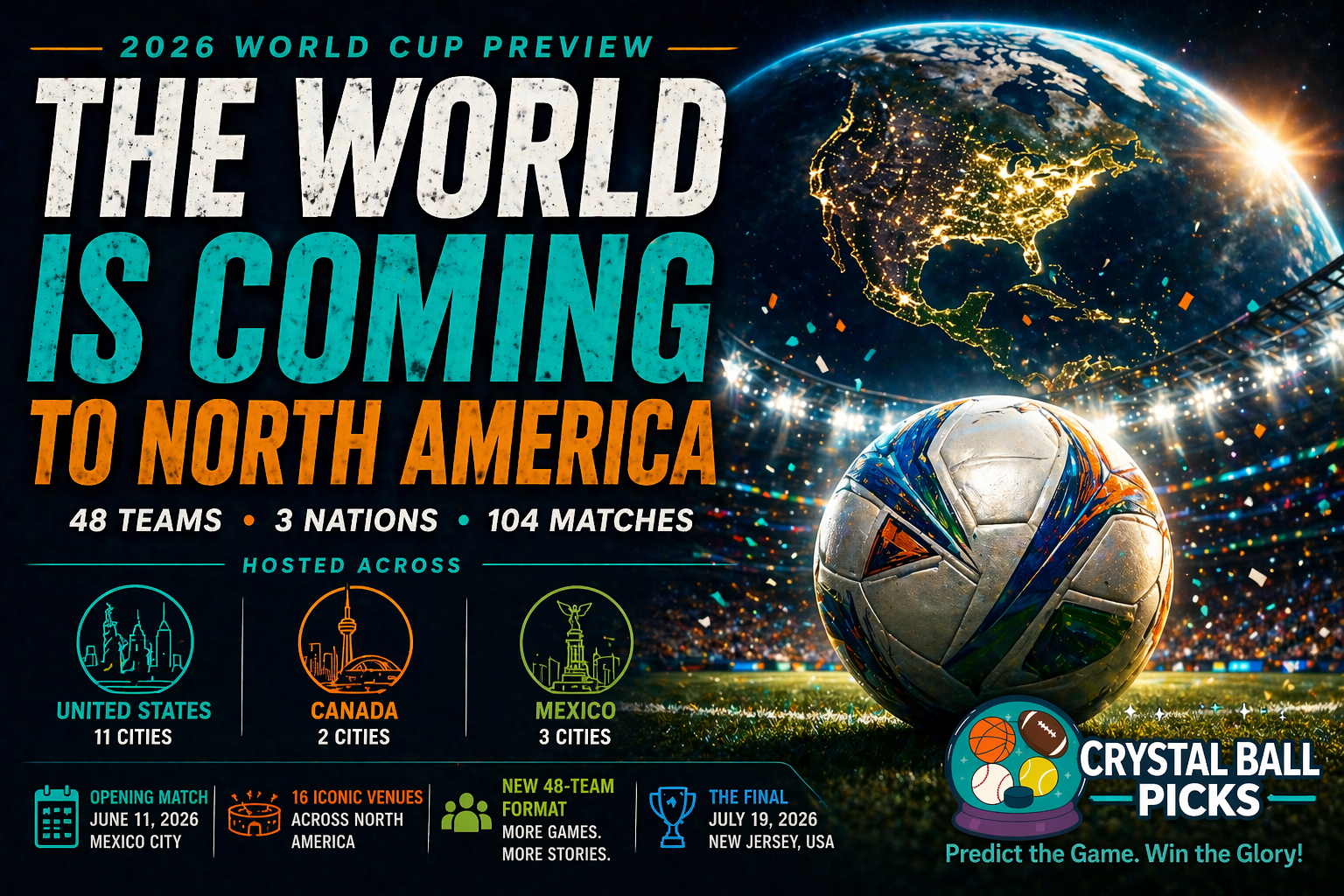
 The 2026 FIFA World Cup begins June 11 across the United States, Canada, and Mexico.
The biggest sporting event on the planet is coming to North America, and the 2026 FIFA World Cup is going to look different from every tournament that came before it.
This is the first World Cup hosted by three countries. It is the first men's World Cup with 48 teams. It will stretch across 16 host cities and feature a record 104 matches from opening day to the final.
For fans in the United States, Canada, and Mexico, that means one thing: the World Cup is no longer something happening far away. It is coming here, and it is going to dominate the sports calendar for more than a month.
If you are looking for the key dates, the host cities, the format, and the biggest storylines heading into the tournament, here is your full guide.
What Fans Want to Know About the 2026 World Cup
Here are the biggest questions people are asking right now:
- When does the 2026 FIFA World Cup start?
- Where is the 2026 World Cup final?
- How does the new 48-team World Cup format work?
- Which cities are hosting matches?
- How many games will be played in the 2026 World Cup?
The short version:
- Tournament dates: June 11-July 19, 2026
- Opening match: Mexico City Stadium, June 11
- Final: New York New Jersey Stadium, July 19
- Teams: 48
- Matches: 104
- Host countries: United States, Canada, Mexico
2026 FIFA World Cup Key Dates
| Milestone | Date |
|---|---|
| Opening Match | June 11, 2026 |
| Group Stage Ends | June 27, 2026 |
| Round of 32 | June 29-July 4, 2026 |
| Round of 16 | July 6-July 9, 2026 |
| Quarterfinals | July 11-July 12, 2026 |
| Semifinals | July 15-July 16, 2026 |
| Third Place Match | July 18, 2026 |
| Final | July 19, 2026 |
The opening match will be played at Mexico City Stadium (Estadio Azteca), while the final is set for New York New Jersey Stadium (MetLife Stadium).
That alone tells you the scale of this event: one of the sport's most historic venues opens the tournament, and one of the biggest stages in American sports closes it.
Host Cities and Venues
The 2026 FIFA World Cup will be played across 16 host cities: 11 in the United States, 2 in Canada, and 3 in Mexico.
United States
| City | Venue |
|---|---|
| New York / New Jersey | New York New Jersey Stadium (MetLife Stadium) |
| Los Angeles | Los Angeles Stadium (SoFi Stadium) |
| Dallas | Dallas Stadium (AT&T Stadium) |
| San Francisco Bay Area | San Francisco Bay Area Stadium (Levi's Stadium) |
| Seattle | Seattle Stadium (Lumen Field) |
| Boston | Boston Stadium (Gillette Stadium) |
| Philadelphia | Philadelphia Stadium (Lincoln Financial Field) |
| Miami | Miami Stadium (Hard Rock Stadium) |
| Kansas City | Kansas City Stadium (Arrowhead Stadium) |
| Atlanta | Atlanta Stadium (Mercedes-Benz Stadium) |
| Houston | Houston Stadium (NRG Stadium) |
Canada
| City | Venue |
|---|---|
| Toronto | Toronto Stadium (BMO Field) |
| Vancouver | BC Place Vancouver |
Mexico
| City | Venue |
|---|---|
| Mexico City | Mexico City Stadium (Estadio Azteca) |
| Guadalajara | Estadio Guadalajara (Estadio Akron) |
| Monterrey | Estadio Monterrey (Estadio BBVA) |
If you are searching for 2026 World Cup host cities or 2026 World Cup venues, this is the full list.
The 48-Team Format: How the 2026 World Cup Works
This is the biggest structural change in modern World Cup history.
The tournament expands from 32 teams to 48 teams, and the format now looks like this:
Group Stage
- 48 teams are divided into 12 groups of 4
- Each team plays 3 group-stage matches
- The top 2 teams in each group advance automatically
- The 8 best third-place teams also advance
That creates a 32-team knockout stage.
Knockout Stage
From there, it is single elimination:
| Round | Teams Remaining |
|---|---|
| Round of 32 | 32 |
| Round of 16 | 16 |
| Quarterfinals | 8 |
| Semifinals | 4 |
| Final | 2 |
The total number of matches increases from 64 to 104, which means more group-stage drama, more knockout matches, and a much busier tournament calendar.
For the finalists, it also means one more game to win the trophy.
Why the 2026 World Cup Is Different
Three Host Nations
The 2026 FIFA World Cup is the first World Cup ever hosted by three countries: the United States, Canada, and Mexico.
That changes the scale of everything. Travel is bigger. Logistics are more complex. Fan movement across borders becomes part of the tournament experience. It is not just a World Cup in North America. It is a World Cup stretched across the continent.
North America Is Not New to Soccer Anymore
When the United States hosted the 1994 World Cup, the sport felt imported. Now it feels embedded.
MLS is bigger. The player pool is deeper. Soccer culture is stronger across the US, Canada, and Mexico. This tournament is not arriving in a region still trying to learn the sport. It is arriving in a region that already lives it.
The Tournament Is Going to Feel Bigger Than Ever
Forty-eight teams. One hundred four matches. More host cities. More fans. More chances for chaos.
That means more underdog runs, more third-place qualification drama, and more storylines than a traditional 32-team World Cup could ever produce.
The Biggest Storylines Heading Into the Tournament
Can the United States Make a Real Run at Home?
The USMNT will not be treated like a novelty story in this tournament. The pressure will be real, the expectations will be higher, and home soil will turn every big match into a major event.
The United States does not just want to host well. It wants to make a run people remember.
What Will the Host Nations Look Like?
Mexico opens the tournament at home. Canada gets a huge stage in front of its own fans. The United States will carry the largest spotlight because of scale and expectations. Together, the three host nations will shape the emotional feel of the tournament before the knockout rounds even begin.
Is This Messi's Last World Cup?
Lionel Messi will be 38 years old when the tournament begins. He already owns the trophy after Argentina's win in 2022, but every World Cup involving Messi now carries the same question: is this the final chapter?
Even if Argentina enters with bigger goals than nostalgia, the possibility of one last Messi run will be one of the central storylines of the summer.
How Much Will the Expanded Format Change the Knockout Round?
A 48-team field means more nations with a path into the Round of 32, which also means more volatility. One surprise third-place qualifier can reshape the bracket. One giant nation slipping in second can change the entire knockout side of the draw.
This format should create more unpredictability than fans are used to seeing.
What the 2026 World Cup Means for Crystal Ball Picks
The 2026 FIFA World Cup is one of the biggest prediction events of the year. With 104 matches across the group stage and knockout rounds, there will be no shortage of chances to make picks, follow results, and stay on top of the tournament inside Crystal Ball Picks.
We will be covering the biggest World Cup storylines between now and the opening match, including favorites to win it all, host nation outlooks, knockout-round predictions, and tournament sleepers.
In the meantime, you can make your match picks throughout the tournament in Crystal Ball Picks.


The 2026 FIFA World Cup runs June 11-July 19 across the United States, Canada, and Mexico. Check back for ongoing coverage, picks, and predictions as the tournament approaches.