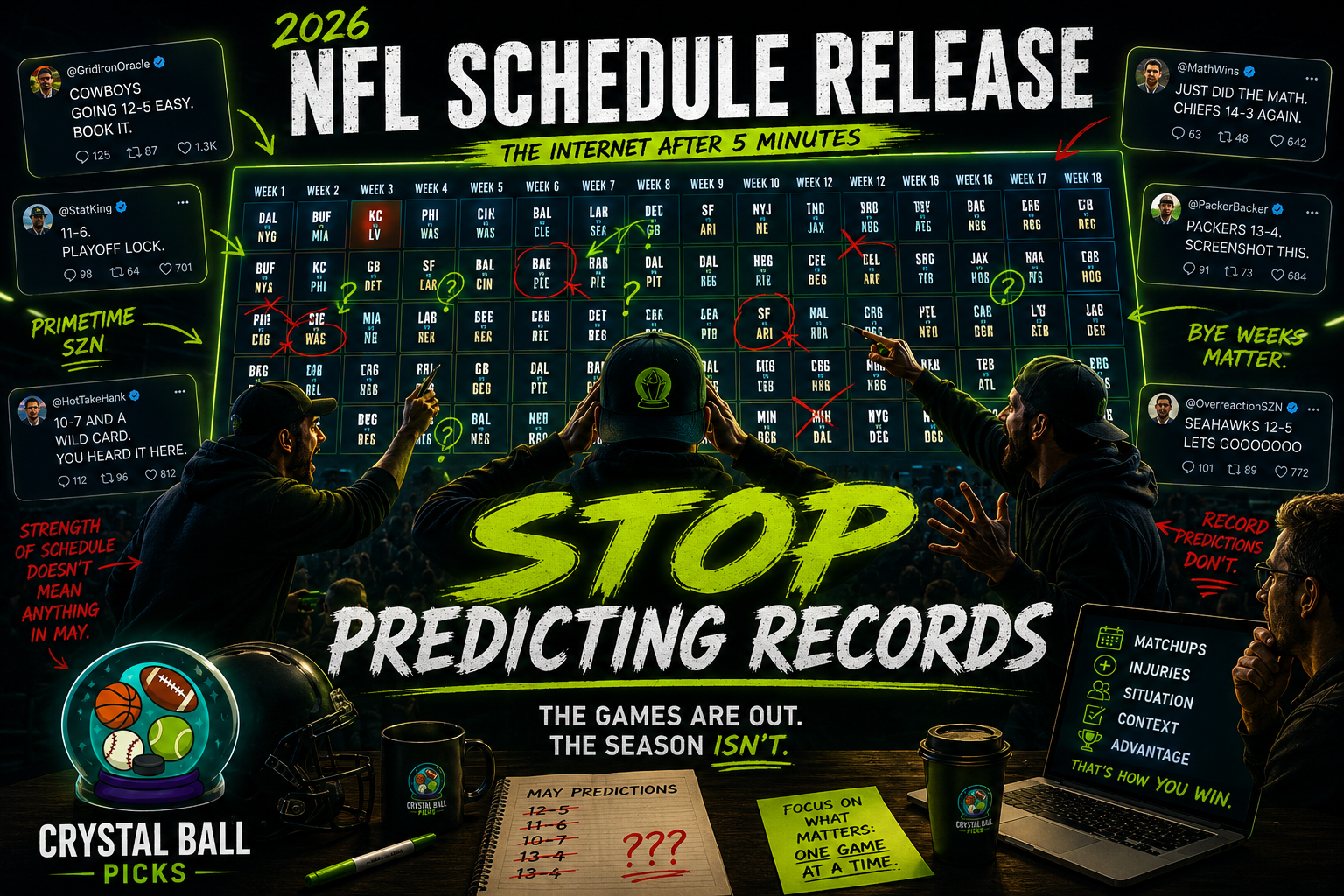
The schedule is out. The takes are already insufferable.
The 2026 NFL schedule dropped Thursday night, and within minutes the internet did what it always does: FOX Sports posted win-loss predictions for all 32 teams. ESPN published its overreactions piece. Every team's fan base spent the evening doing the math, circling wins, crossing out losses, arriving at a record that feels exactly right because it tells them what they already wanted to believe.
The Dolphins fans are going 2-15. The Cowboys fans are going 12-5. The Browns fans have already found a way to go 10-7 and sneak into the playoffs. Everyone is going to the Super Bowl, or the draft lottery in spirit, if you ask the right fan base.
It is one of the great annual rituals in American sports. It is also almost entirely meaningless.
The Problem With Predicting Records in May
Here is what you are actually doing when you predict an NFL team's record in the middle of May: you are taking last year's roster, applying it to next year's schedule, and assuming nothing changes in between. That is not analysis. That is a spreadsheet with a confidence problem.
Consider what you do not know right now. You do not know who gets hurt in training camp. You do not know which offensive lineman tears an ACL in Week 2 and changes the entire character of a team's season. You do not know which quarterback regresses, which young receiver breaks out, which head coach loses the locker room by October. You do not know which team that looks great on paper in May quietly implodes by Thanksgiving, and which 7-10 team from last year figured something out in the offseason that nobody noticed yet.
The NFL has a salary cap and a parity structure specifically designed to scramble the standings every year. It works. Last year's powerhouse is this year's disappointment with alarming regularity. Predicting records assumes a stability that the league simply does not provide.
And then there is strength of schedule, which analysts are already using to crown winners and losers from the schedule release. The Bears drew the hardest schedule in the league based on 2025 opponent win totals. The Browns drew the easiest. People are already drawing conclusions. The problem is that strength of schedule is calculated using last year's records, from a completely different set of rosters, in a league where things change dramatically every offseason. It is a measurement of the past being used to predict the future, and it has a genuinely poor track record of doing so accurately.
Even the teams that look like they drew a soft path in May often get to October and realize half the league is not what it looked like on paper. That is the whole point. The inputs are unstable from the start.
What the Schedule Release Is Actually Good For
None of this means the schedule release is not fun. It absolutely is. It just means the fun is in different places than most people are looking.
The season opener is worth getting excited about. The Seahawks host the Patriots on September 9 in a rematch of Super Bowl LX, the defending champions welcoming the team they beat for the title. That is a real game with real stakes and real storylines, and circling it on the calendar is completely reasonable.
Thanksgiving week is stacked. The NFL scheduled a Thanksgiving Eve game for the first time, Rams vs. Packers on Netflix, followed by Chiefs-Bills on Thanksgiving Day itself. Patrick Mahomes against Josh Allen, on a short week, in late November, when the AFC standings are starting to take shape. That one has been good before and will probably be good again.
Christmas delivers too. Bears-Packers at 1 p.m., Bills-Broncos at 4:30, Rams-Seahawks in Seattle to close it out. The NFL has figured out that Christmas is a good football day, and this slate makes the case.
The primetime picture tells you something about where the league thinks the storylines are heading. The Seahawks get a franchise-record six primetime games. The Chiefs, Packers, and Cowboys each get six as well. The Bears get five. That is the league making a bet on which teams and markets will be worth watching in the fall, and it is at least an informed bet even if it is not a guaranteed one.
These are the things worth circling. The marquee matchups. The trap games buried in November. The stretches where a team plays three road games in four weeks. The bye week timing. That is real, useful information about what the season might look and feel like.
The Only Honest Way to Watch Football
The record predictions will keep coming. They always do. And honestly, some of them are fun to read, not because they are accurate but because they reveal what each fan base is hoping for, and hope is its own kind of entertainment.
But if you actually want to engage with the NFL in a way that holds up to scrutiny, game by game is the only honest unit. Not the season. Not the division. The game in front of you, with the information you have that week, accounting for who is healthy and who is not, which team is coming off a bye and which is playing on a short week, which quarterback just had the worst game of his season and which defense is quietly the best in the league.
That is where the real decisions get made. Not in May, staring at a schedule grid and doing arithmetic that will be wrong in ways you cannot yet anticipate.
The schedule is out. The games are not. There is a difference, and it matters.
Make your NFL picks game by game all season long at Crystal Ball Picks.