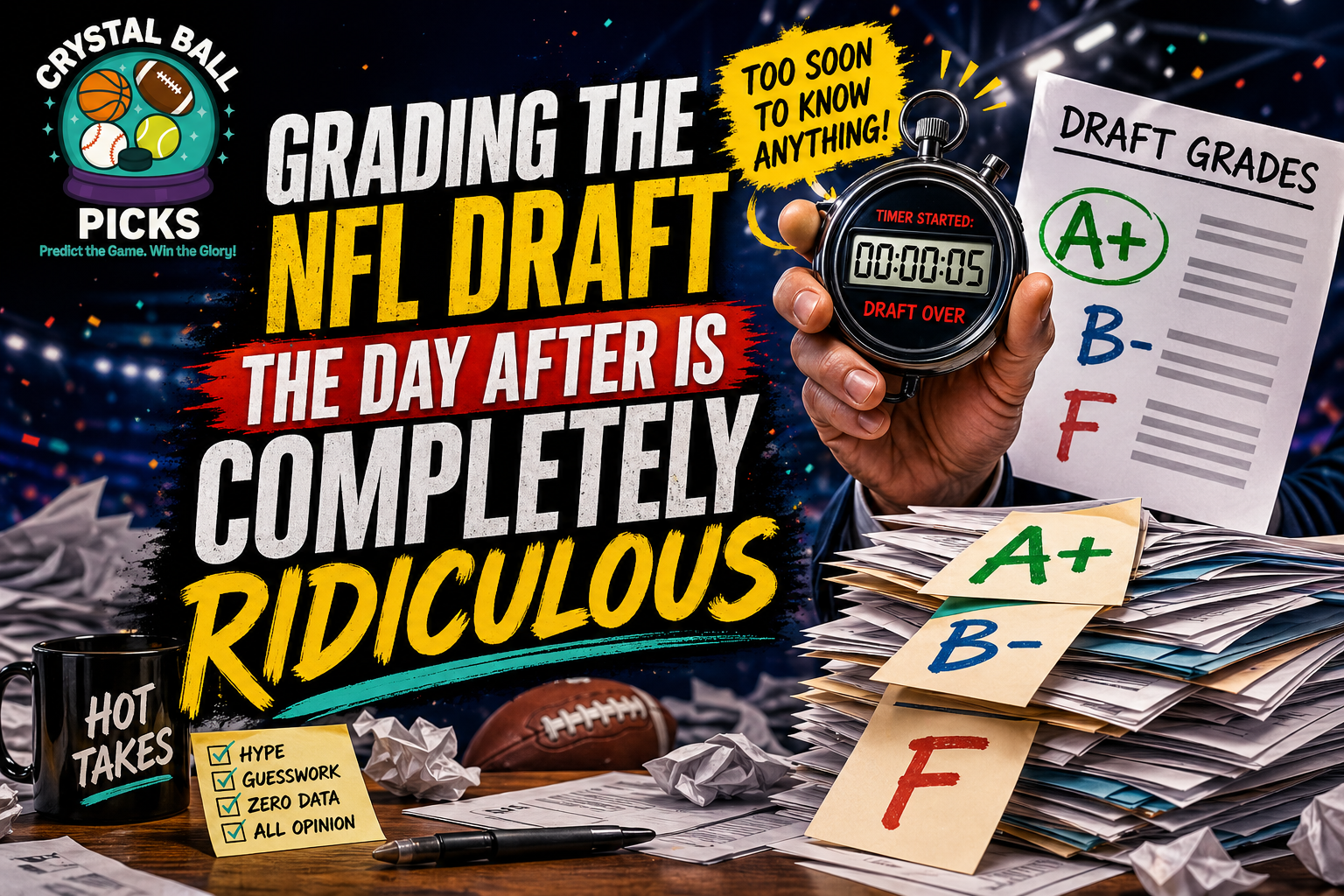
 Hot takes and letter grades before anyone has played a single NFL snap.
Every year, the NFL Draft ends on a Saturday and by Sunday morning the internet is buried in report cards. Team A got an A-minus. Team B got a C-plus. The Rams made a terrible pick. The Giants crushed the weekend. Everyone has a grade, a winner, a loser, and a neat little package ready to go before breakfast.
None of it means very much. And deep down, everybody knows it.
You Are Grading Players Who Have Not Played Yet
Start with the obvious problem.
An instant draft grade is an evaluation of players who have never taken a single NFL snap. The people handing out those grades are working from college tape, athletic testing, interviews, consensus boards, and whatever reporting they gathered before the draft. That information matters. It just is not enough to tell you who actually drafted well.
College stars fail all the time. Raw prospects become Pro Bowlers. Players who looked like reaches in April end up looking like steals by Year 3.
Tom Brady was a sixth-round pick. Aaron Rodgers sat in the green room for 23 selections. If draft grading were anywhere close to reliable, the league would not miss on first-rounders as often as it does.
The draft is not a solved problem. If it were, teams would not keep getting it wrong.
Teams Know Things Analysts Do Not
This is the part people forget when they rush to grade every pick.
NFL teams have information the public does not. They spend months interviewing prospects. They dig through medical evaluations. They meet with families. They test football intelligence. They know which traits fit their scheme and which ones do not.
A pick that looks strange on a consensus board might make perfect sense inside a specific system.
The Rams taking Ty Simpson at No. 13 is a good example. A lot of immediate reaction pieces crushed the pick. Maybe those critics will end up being right. But the truth is simple: nobody writing a grade Saturday night had access to the full evaluation the Rams spent months building.
That does not mean teams are always smarter than the public. It means outside analysts are grading with missing information from the start.
The Best Defense of Draft Grades Still Falls Short
To be fair, the people who hand out instant draft grades would say they are not trying to predict a full NFL career in 12 hours.
They would say they are grading:
- value at the draft slot
- process
- positional need
- trade decisions
That is the strongest argument in favor of instant grades, and it is more reasonable than pretending anyone knows who the future All-Pros are.
But even that version still falls short.
Why? Because "value" is usually based on public rankings, not private team boards. "Need" is often framed by fan assumptions, not how the coaching staff actually wants to build the roster. And "process" is still being judged without access to the full medical, interview, and scheme information that shaped the pick.
So even the smarter version of draft grading is still mostly an incomplete guess.
The Grades Are Mostly About Familiarity
Be honest about how these things usually work.
When a team takes a player everyone knows - a big-name SEC prospect, a combine riser, or a guy who lived on mock drafts for six months - the reaction is usually positive. The pick feels safe because it is familiar.
When a team takes a smaller-school prospect, trades back, or addresses a position that casual fans were not focused on, the grade drops. Not always because the move was wrong, but because it takes more explanation than the instant-take cycle allows.
Familiarity gets mistaken for value all the time.
That is not analysis. That is comfort.
It Is Content, Not Analysis
This is the real answer.
Draft grades exist because the NFL Draft is one of the biggest content events on the sports calendar and the appetite for takes does not end when the final pick is announced.
Writers need something fast. Networks need debate. Fans want to know how to feel about their team's weekend.
Letter grades solve all of that. They feel analytical. They are easy to share. They create arguments. And because the timeline for proving them wrong is years away, almost nobody is ever seriously held accountable for how bad the original grade was.
By the time we know what the 2026 draft classes actually became, the cycle will already be onto 2027.
When Can You Actually Grade a Draft?
Three years. Minimum.
That is when you can start asking real questions:
- Did the first-round picks become starters?
- Did the middle-round picks make the roster and contribute?
- Did the team find value outside the top 100?
- Did the class help the roster get better in a meaningful way?
The 2026 NFL Draft will not be truly gradeable until 2029 at the earliest. Everything before that is just projection dressed up as certainty.
What a Smarter Draft Review Looks Like
If you still want to evaluate what your team did, there are better questions than "what letter grade did they get?"
Did the team address real roster problems?
A great player at a position of depth can still be a wasted opportunity if the roster has obvious holes elsewhere.
Did the team handle trade value well?
Trading down for more picks is usually underrated. Trading up for a player who might have lasted another round is usually overrated.
Do the picks match the coaching staff and timeline?
A rebuilding team should draft differently than a contender. A zone-heavy defense should evaluate corners differently than a man-heavy one. Fit matters.
That kind of draft review is still imperfect, but at least it asks real football questions instead of pretending Sunday morning letter grades tell the whole story.
Enjoy the Draft - Just Do Not Confuse the Hype With Information
The draft is one of the best weekends in sports. The trades, the surprises, the cameras on nervous prospects, the fans booing commissioners, the wild reach discourse - all of it is great theater.
Enjoy it.
Just do not confuse all that noise with actual knowledge.
The players who looked like reaches might be stars in four years. The picks everyone loved might be gone by Year 2. The real grade comes later, when the players actually play.
Until then, the smartest thing you can say about a draft class is usually this:
We will see.
Make your predictions in Crystal Ball Picks and see who called it right when the season actually starts.