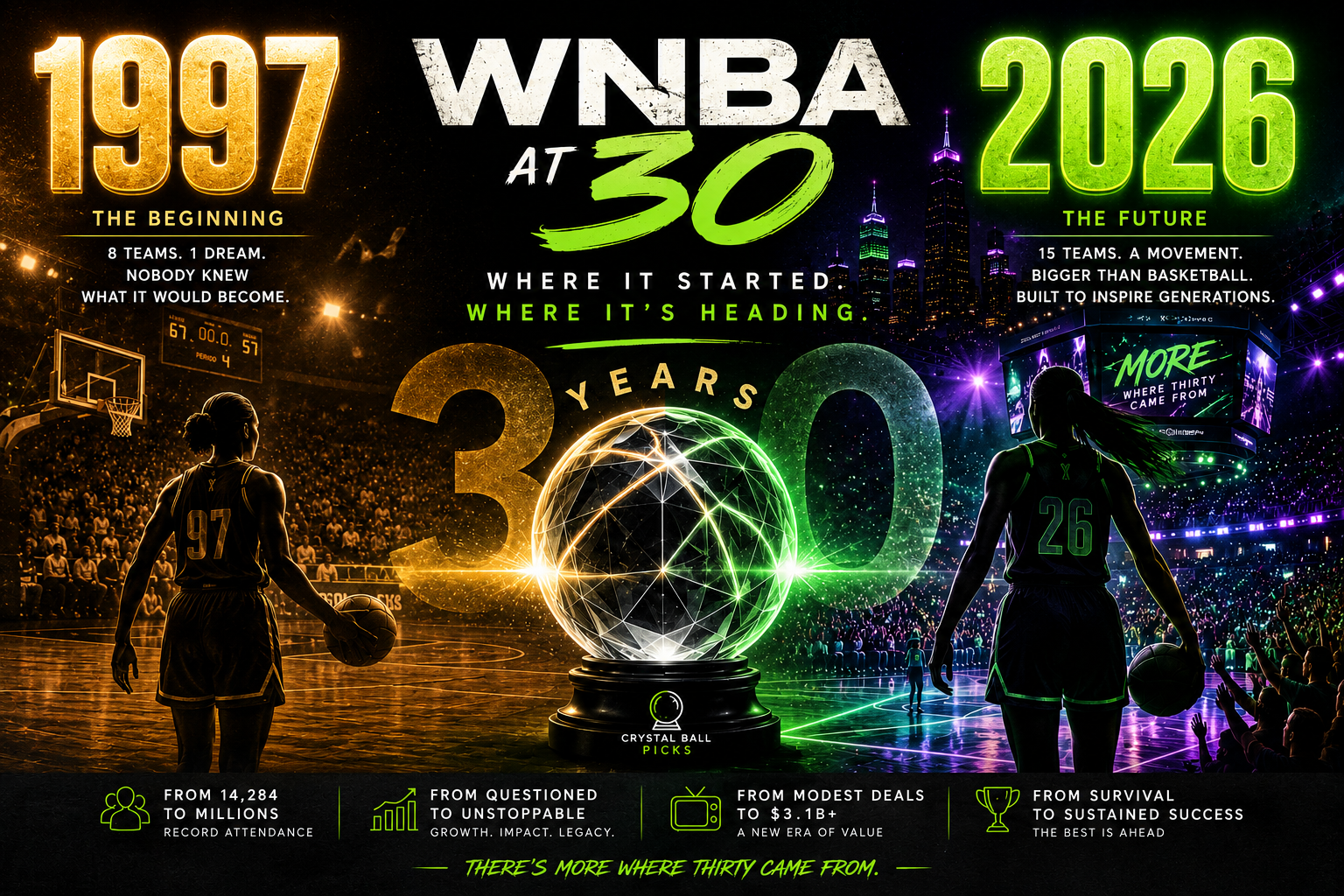
Thirty years. Fifteen teams. One league that refused to fold.
On June 21, 1997, the New York Liberty defeated the Los Angeles Sparks 67-57 at the Great Western Forum in Inglewood, California, in front of 14,284 fans. It was the first WNBA game ever played. Nobody knew what it would become. Most people were not even sure it would last.
On June 21, 2026, the Los Angeles Sparks will host the New York Liberty in a rematch the league planned as part of its 30th-season celebration. The teams are still here. The league is still here. And the world it exists in looks nothing like the one that game was born into.
WNBA at 30: What Changed
- Teams: from 8 in 1997 to 15 in 2026
- Expansion path: 18 teams approved by 2030
- Media rights: from survival-era TV windows to a multibillion-dollar rights package
- Player pay: from salaries that required overseas work to a dramatically richer 2026 CBA
- Audience: from niche summer curiosity to one of the fastest-growing brands in sports
Where It Started
The WNBA was founded on April 24, 1996, when the NBA Board of Governors approved the concept of a new women's professional league set to begin play in June 1997. The league launched with eight franchises, each tied to an NBA city: Charlotte, Cleveland, Houston, Los Angeles, New York, Phoenix, Sacramento, and Utah.
Three players became the first faces of the league: Lisa Leslie, Rebecca Lobo, and Sheryl Swoopes. When the WNBA was announced, those names gave the league instant credibility.
Swoopes was the first player officially signed and one of the most important stars of the early years. A six-time All-Star, three-time MVP, and four-time champion, she helped give the league both legitimacy and edge. But the engine of the early league was in Houston, where Cynthia Cooper averaged more than 22 points per game and led the Comets to four consecutive championships from 1997 to 2000. That run, including a 27-3 season in 1998, remains one of the defining dynasties in league history.
Lisa Leslie delivered one of the league's signature milestones in 2002 when she became the first player to dunk in WNBA history. She played 12 seasons for the Sparks, won three MVP awards, collected four Olympic gold medals, and retired as one of the league's foundational stars. She is one of the clearest symbols of what the WNBA looked like when it was still trying to prove it belonged.
The Years Nobody Talks About
Not everything held. The Houston Comets, the dynasty franchise that defined the league's early identity, folded in 2008. The Charlotte Sting went dark in 2006. The Cleveland Rockers in 2003. The Sacramento Monarchs in 2009. Four of the original eight franchises are gone.
Of those original eight, only four remain active today: the Las Vegas Aces, formerly the Utah Starzz, the Los Angeles Sparks, the New York Liberty, and the Phoenix Mercury.
There were years when the league's survival was not guaranteed. Years when average attendance was soft, TV deals were modest, and the conversation about whether women's professional basketball could sustain itself in America was entirely legitimate. The league kept going anyway. It found ways to stay alive, add teams carefully, and build toward something it could not yet fully see.
The Explosion
2024 changed everything.
Caitlin Clark entered the league as the No. 1 overall pick and the most hyped rookie in WNBA history. What followed was not hype. It was a transformation. Total attendance that season reached 2,353,735, up 48 percent from the year before and the highest in 22 years. Average viewership per game across ESPN platforms hit 1.19 million, up 170 percent year over year. The All-Star Game drew 3.4 million viewers. Merchandise sales exploded.
Then Clark missed most of 2025 with injuries. The league grew anyway. Total attendance broke the all-time record set in 2002. The ESPN season average was about 1.2 million viewers, and the 2025 Finals Game 1 drew 1.9 million viewers. The growth had taken root in something bigger than one player.
The Business of 30
In 2024, the WNBA signed a new 11-year media rights package running through 2036 with Disney, NBCUniversal, and Amazon Prime Video, with additional distribution across partners including CBS, ION, USA Network, and NBA TV. The value of the package has been widely reported at more than $3 billion. The previous deal averaged roughly $43 million per year. The new one is on a completely different scale. That is not an incremental improvement. That is a different league.
The new Collective Bargaining Agreement matched the moment. A tentative deal was reached in March 2026, with reporting centered on a salary cap jump from $1.5 million to $7 million, a supermax salary rising to $1.4 million, and minimum salaries moving well above the old floor. For the first time in the league's history, players are finally positioned to build a real career without depending on overseas contracts just to make the economics work.
The 30th Season
The 2026 WNBA season, the league's 30th, opened May 8 with 15 franchises and the tagline "There's More Where Thirty Came From." Two new teams joined: the Portland Fire, a revival of a franchise that last played more than two decades ago, and the Toronto Tempo, the first international WNBA franchise in league history.
The stars are as good as they have ever been. A'ja Wilson is chasing a fifth MVP award, something that has never been done. Breanna Stewart opened the season with 31 points, 10 rebounds, and 3 blocks. Clark is healthy, Paige Bueckers is in her second year, and the conversation about who the best player in the league is has never been more interesting or more watched. We took a closer look at the Clark vs. Bueckers debate if you want to dig deeper. For a full breakdown of the season, see our 2026 WNBA Season Preview.
The league has committed to reaching 18 teams by 2030, with Cleveland, Detroit, and Philadelphia all formally approved. Cleveland, which lost the Rockers in 2003, gets a full-circle moment of its own. Expansion fees have risen sharply, and the market is making the league's value impossible to ignore.
Where It Goes
Thirty years ago, eight teams played in front of crowds that were not sure they were watching something that would last. Today the question is not whether the WNBA survives. The question is how big it gets.
Part of the answer is the college game. The NCAA Women's Tournament has become appointment television in a way it never was before, drawing record viewership, selling out arenas, and generating the kind of national conversation that used to belong almost entirely to the men's game. That did not happen by accident.
It happened because a generation of players arrived at the biggest programs in the country and made women's basketball required watching before they ever played a professional minute. Caitlin Clark. Angel Reese. Paige Bueckers. These were not players the WNBA had to introduce from scratch. They arrived with audiences of millions and fan bases that followed them from college arenas straight into the professional game. And they are not the last ones coming.
The pipeline is producing stars at a rate the league has never seen, and each year's draft class arrives already known, already debated, already watched. The players who built this league through the years nobody talks about made the explosion possible. The players in it right now are making it undeniable.
On June 21, 2026, the Sparks host the Liberty in Los Angeles. Same two teams. Same city where it started. Three decades later, the WNBA looks nothing like the league people doubted in 1997, and everything like the league its believers were trying to build.
Make your WNBA picks all season long at Crystal Ball Picks.